
What Is Pickaxe Mountain? Iran’s Secretive Underground Facility Trump Says the US Could Attack
Pickaxe Mountain is a heavily fortified underground facility near Iran's Natanz nuclear complex. After Donald Trump suggested the US could target it, the site has become central to concerns over Iran's nuclear program, regional tensions, and the risk of further military escalation.
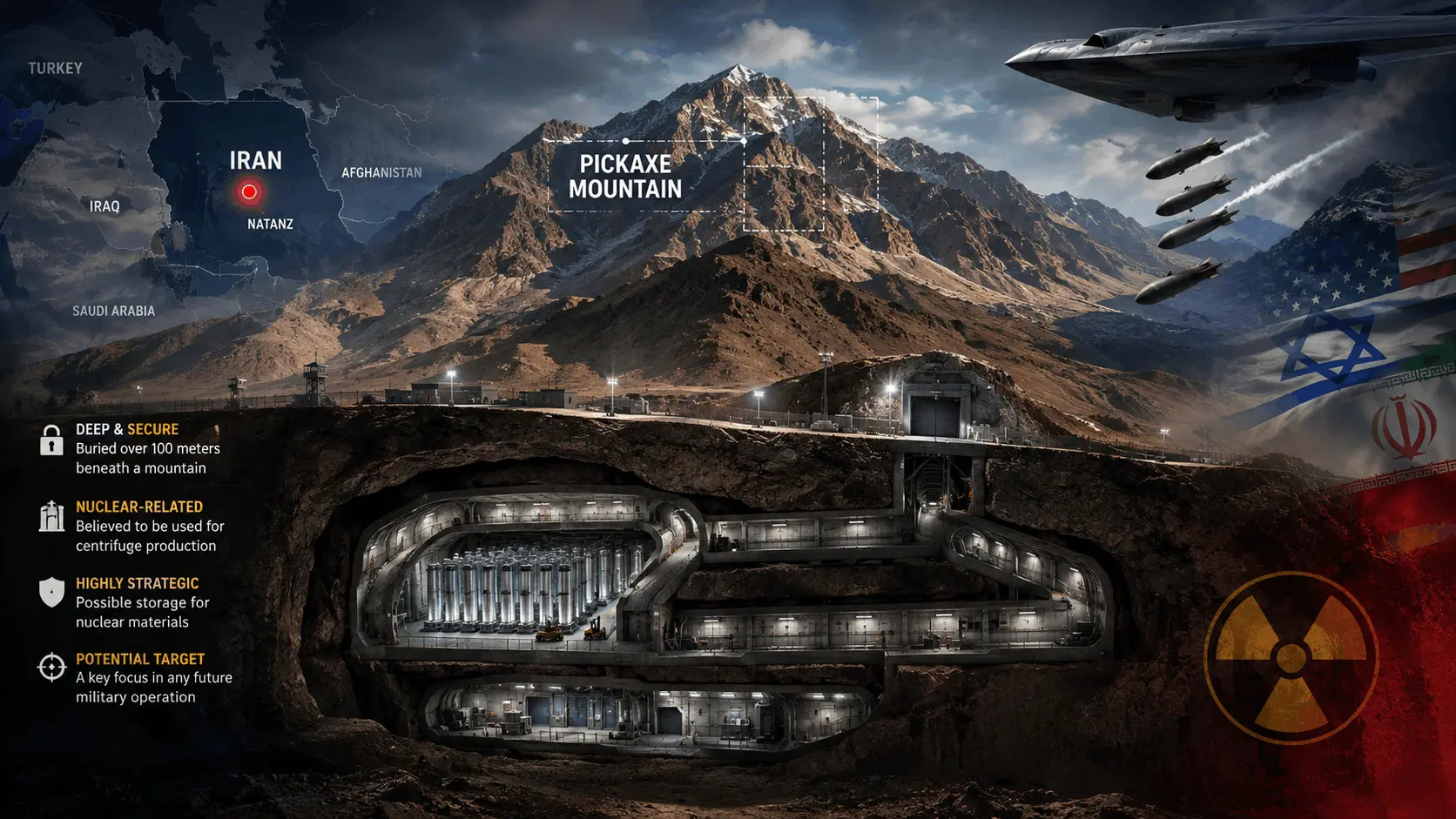
US President Donald Trump has once again raised the possibility of a US attack on Iran’s heavily fortified Pickaxe Mountain facility, bringing renewed international attention to one of Tehran’s most secretive nuclear-related sites.
Speaking on Tuesday, Trump said the United States would “very probably” strike the area soon, adding that Iran would be unable to prevent such an attack.
Iran has warned that any US strike on its nuclear facilities would be considered an expansion of the ongoing regional conflict. The threat has further intensified concerns over the future of Iran’s nuclear program and the possibility of another direct confrontation between Tehran and Washington.
But what exactly is Pickaxe Mountain, and why has it become a potential target?
What Is Pickaxe Mountain?
Pickaxe Mountain is a heavily fortified underground facility located in central Iran, approximately one mile south of the Natanz uranium-enrichment complex.
The facility is believed to be buried at least 100 meters, or around 328 feet, beneath a large mountain known as Kuh-e Kolang Gaz La. The word “Kolang” translates to “pickaxe,” which is how the site came to be known as Pickaxe Mountain.
Its location deep beneath the mountain makes the facility extremely difficult to target. The depth of the site could make conventional airstrikes less effective, while any ground operation would likely be highly complex and dangerous.
Construction at the facility began in 2020. Iran informed the International Atomic Energy Agency that the site was intended to become a facility for assembling centrifuge machines used to enrich uranium and produce nuclear fuel.
However, the facility has remained shrouded in secrecy. There are no comprehensive public schematics of the location, and the majority of what is known about it comes from satellite photography and nuclear specialists' analysis.
What Do Satellite Images Reveal?
According to experts, satellite images indicate that Pickaxe Mountain contains multiple tunnel complexes and a large security perimeter.
The entrances to the facility appear to have been reinforced with concrete, potentially to protect them from airstrikes. In recent years, construction is also thought to have proceeded.
Experts say activity at the site may have increased following attacks on Iran’s other nuclear facilities in June 2025, including the nearby Natanz complex.
There are several possible explanations for the construction and expansion of the site.
Iran may be building centrifuges there, as it previously told the UN nuclear watchdog. Tehran may also be moving operations from nuclear plants that were destroyed or damaged in earlier attacks.
Some analysts, however, are concerned that the facility would eventually be utilized for uranium enrichment, including operations that might aid in the creation of nuclear weapons.
Has Iran Moved Enriched Uranium There?
Whether Iran has relocated some of its advanced centrifuges and enriched uranium stockpile to the subterranean site is one of the most important mysteries concerning Pickaxe Mountain.
Israeli intelligence claims that following attacks on its nuclear facilities, Iran relocated some of its sophisticated enrichment apparatus and nuclear material to the site.
During the 12-day conflict in June 2025, Israel attacked a number of significant Iranian nuclear sites, notably those in Fordow, Isfahan, and Natanz. The United States later joined the military campaign and also attacked the same facilities with powerful bombs.
Trump later asserted that Iran had "obliterated" its nuclear capability.
Though they were severely damaged, intelligence assessments from the United States and the United Nations later suggested that portions of Iran's nuclear program might have survived the assaults.
It is thought that Iran has sizable reserves of highly enriched uranium. Concerns over the material's future have been voiced by both the US and Israel, who have advocated for its removal or neutralization.
According to reports, Iran has sealed tunnels and erected barriers around entry points in order to preserve its stockpile of enriched uranium.
However, Trump said Tuesday that there was no confirmed record showing that Iran had moved its advanced centrifuges to Pickaxe Mountain.
Iran has also denied claims that nuclear activities are taking place at the site. Tehran insists that its nuclear program is entirely peaceful and is intended to meet the country’s energy requirements.
Could the United States and Israel Attack the Facility?
Experts continue to disagree on whether Pickaxe Mountain might be successfully attacked.
The factory should be targeted, according to some nonproliferation experts, in order to stop Iran from continuing its uranium-enrichment capabilities.
The structure would require energy, ventilation, and heating and cooling systems. It would also need regular deliveries of equipment and supplies, as well as personnel. Analysts believe these support systems could create potential vulnerabilities that could be targeted by the United States or Israel.
However, since the facility's most crucial parts are thought to be deep underground, airstrikes might not be able to totally destroy it.
A ground operation would likely be even more complicated, requiring troops to enter a heavily fortified facility buried beneath a mountain.
Would an Attack Destroy Iran’s Nuclear Program?
Some experts believe that an attack could damage the facility and prevent it from operating for some time.
Others are more skeptical.
Nuclear policy expert James Acton has argued that the United States may be able to do little more than collapse access tunnels leading to the site. In his assessment, such an attack would not necessarily represent a decisive blow to Iran’s nuclear capabilities.
Is it possible to permanently stop Iran from reconstructing the facility by demolishing the entrances and access routes?
Why Pickaxe Mountain Matters
Pickaxe Mountain has become increasingly important because of its location, depth, and potential connection to Iran’s nuclear program.
Unlike facilities that are visible above ground, the underground site is difficult to monitor and even harder to destroy. Its suspected connection to centrifuge production and the possibility that Iran could use it to protect nuclear equipment or enriched uranium have made it a major concern for Israel and the United States.
Trump’s latest warning has once again placed the facility at the center of growing tensions between Washington and Tehran.
If the United States does attack Pickaxe Mountain, it could mark a significant escalation in the conflict and potentially trigger a wider regional confrontation. For now, however, key questions remain unanswered, including whether Iran has actually moved enriched uranium or advanced centrifuges to the site and whether any military strike could truly eliminate the facility’s nuclear capabilities.
Comments (0)
Login to join the discussion and share your thoughts.
No comments yet. Be the first to comment.