
As regional security concerns are raised by the Hormuz ship attacks, India calls for an immediate de-escalation.
India has strongly condemned attacks on commercial ships passing through the Strait of Hormuz and called for an immediate end to hostilities in response to the renewed unrest in West Asia.
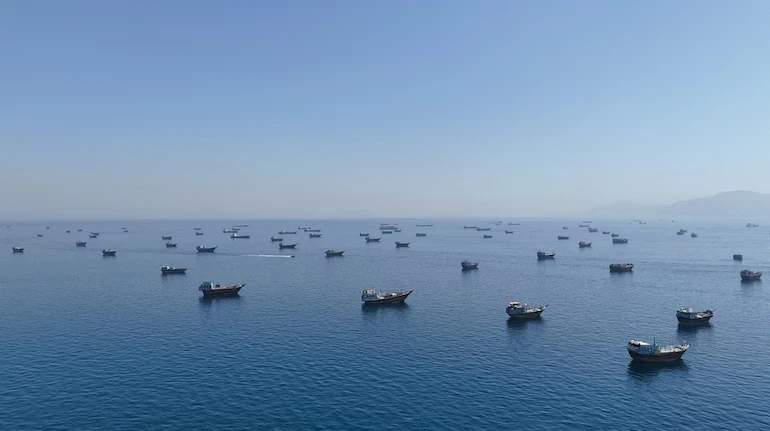
India has expressed grave concern at the resurgence of turmoil in West Asia, strongly denouncing attacks on commercial ships transiting through the Strait of Hormuz and demanding an immediate end to hostilities.
India's Permanent Representative to the UN, Ambassador Parvathaneni Harish, stated that the most recent escalation was a serious concern for the international community during an open discussion on the Middle East issue in the UN Security Council.
He called on the participating countries to cease escalating hostilities and to resume diplomatic relations and negotiations.
Indian nationals among those affected
India's concerns are particularly strong because Indian citizens were among those impacted by the attacks on maritime vessels.
Harish referred to incidents involving ships, including GFS Galaxy, MT Al Bahiyah, and MT Mombasa, while they were travelling through the Strait of Hormuz.
India's statement claims that a number of Indian citizens were hurt, some of them critically. One Indian national was killed, while another is still missing.
Attacks on seafarers and interference with commercial maritime channels have consistently been resisted by New Delhi. India underlined that international waterways must remain safe and accessible for both civilian and business use.
Hormuz crisis threatens global shipping
One of the most strategically significant maritime routes in the globe is the Strait of Hormuz; thus, the most recent disruption is a concern that extends far beyond West Asia.
Following attacks on commercial ships earlier this month, the UN has reported a significant drop in vessel movements through the river. Following Iran's announcement of the strait's closure, daily vessel movements drastically decreased in comparison to pre-conflict levels.
Thus, in compliance with international law, India has demanded the resumption of unhindered commercial activity and navigation through international waterways.
Attacks on civilian facilities and commercial ships must end, according to New Delhi, and diplomatic initiatives should take precedence over more military escalation.
Why India is closely watching the conflict
India has important geopolitical and economic ties to the Gulf and the larger West Asian area.
India's energy supply lines and trade are heavily linked to the region. With annual bilateral trade of over $180 billion, cumulative foreign investment above $31 billion, and remittance inflows exceeding $52 billion, India also has substantial economic links with the countries of the Gulf Cooperation Council.
The Gulf countries are home to and employ close to 10 million Indians.
As unrest continues to spread throughout the region, New Delhi has made ensuring their safety a top concern.
Long-term shipping delays over Hormuz may have broader effects on international trade, energy supply, and transportation expenses.
India calls for diplomacy over further conflict
India has called on all parties to stop escalating the situation and start talking again.
Harish underlined that attacks and hostilities of this nature cannot bring long-term stability and peace in West Asia. According to India, diplomacy remains the most practical means of resolving the disputes in the region.
New Delhi has also stressed that during the crisis, civilian facilities and commercial ships should not be targeted.
The proposal comes at a time when concerns about the possibility that continued military action could lead to an even more severe regional conflict are becoming more widespread.
Gaza crisis must not be forgotten
India highlighted the dangers of the Strait of Hormuz and warned the international community not to allow the maritime situation to overshadow the humanitarian crisis in Gaza.
Harish asserts that human casualties and damage to critical infrastructure are still major problems that require immediate global attention.
India reaffirmed its commitment to providing development and humanitarian help to Palestinians with an estimated $175 million in aid.
Additionally, New Delhi reiterated its long-standing support for a political settlement predicated on the establishment of a Palestinian state that coexists with Israel within acknowledged and safe boundaries and is viable, independent, and sovereign.
India strikes a balance between humanitarian and security issues
India's recent UN intervention is a reflection of the nation's larger worries about the effects of protracted unrest in West Asia.
For New Delhi, the issue is not only about regional security. Trade routes, the global economy, the energy supply, and the safety of Indian citizens are all directly impacted by developments in the area.
In view of the current tensions surrounding the Strait of Hormuz, India is pushing for stronger diplomatic engagement, free international waterways, and moderation.
Preventing more assaults on shipping and civilians while making room for talks that can resolve the larger war is the current dilemma.
India's stance in the Security Council is unambiguous: civilian safety and freedom of navigation must be maintained while the area needs diplomacy and de-escalation.


Comments (0)
Login to join the discussion and share your thoughts.
No comments yet. Be the first to comment.